Sunday, October 31, 2010

What were your reactions to the shooting of Candy's dog In Of Mice and Men?

I had three reactions when Candy's dog was shot. 


First, the world of the men on the ranch was a brutal one that was based on what one could do. In other words, Candy's dog was basically useless now because of its age.  It was once a great dog, but now it just existed.  In this world, uselessness equals death.  


Second, I thought Candy was next.  Candy was pretty much useless as well on account of his age and his handicap. In light of this, I felt very sorry for Candy's future.  Slim, who is he most respected person on the ranch, says these words: "I wisht somebody’d shoot me if I get old an’ a cripple."


Third, I thought that Carlson, the one who shot the dog, was representative of the other men. In other words, the other men gave their approval of the shooting as well.  This shows that the men may have a point.  Perhaps it was most merciful to put down the dog.  Therefore, the theme of euthanasia is introduced. 

How did Hawaii become part of the United States?

Hawai’i originally became part of the United States when people of American descent living in Hawai’i overthrew the native Hawai’ian monarchy.  Not long after, they were able to prevail upon the United States to annex Hawai’i, making it a territory of the United States.  Roughly 60 years later, Hawai’i became the 50th state in the Union.


Hawai’i was originally an independent nation.  It eventually came to be ruled by a monarchy that had united all of the islands in the chain.  Beginning in the 1820s, Americans started to come to the islands, largely as missionaries.  Eventually, Americans became very involved in the Hawai’ian economy and were some of the biggest landowners in the country.  These Americans built a massive sugar industry on the islands.


In 1887, Americans in Hawai’i forced King Kalakaua to sign the “Bayonet Constitution,” taking many of the powers away from the monarchy.  They wanted more control over the islands for themselves.  In 1893, when Queen Liliuokalani tried to restore some of these powers, they deposed her with help from American military forces.  The islands remained independent, but under the rule of the American elites, for a few years.  Then, in 1898, the US government agreed to annex Hawai’i during the Spanish-American War.  The islands continued to be a US territory until 1959, when they achieved statehood. 


It is this history that makes many native Hawai’ians feel that their land was taken from them and that they should be given sovereignty over it once again.

Why does Beowulf slay Grendel?

Beowulf doesn't really announce a specific reason for his intention to slay Grendel. The tone of the poem, and the manner in which the author regards Grendel (calling him hellspawn and a descendant of Cain, who killed his own brother and was damned to wander the earth forever), makes it clear that the author means for us to interpret Grendel as a near-supernatural, purely evil entity with no redeeming qualities nor any possibility of negotiation or peace. Just as good and evil are clearly delineated in the Biblical sources the author draws upon, so too is Grendel clearly evil and therefore deserving of retribution and death, according to this morality. Beowulf doesn't need to explain why he kills Grendel because, as far as the author and the characters in the context of the poem are concerned, it is self-evident that Grendel must be slain in order to stop the attacks on Heorot.


There is a small concession to diplomacy on lines 154 to 160, where it is mentioned that Grendel has no intention of stopping his attacks, and nobody expected him to pay the money normally demanded of a murderer to stave off retribution from the murdered person's kinsmen. 


Beowulf does mention, beginning at line 960, that he wishes Hrothgar could have seen Grendel rather than just his disembodied arm; Beowulf wanted to grapple Grendel into submission and then kill him, but by chance, Grendel was too slippery for Beowulf to completely subdue. Beowulf states that Grendel basically "traded his arm for his life", but he knows the wound was mortal and Grendel is likely dead already.

What is a hook for an essay talking about green in The Great Gatsby?

You might consider addressing the various emotions and objects with which green is frequently identified, and then tying those to your discussion and analysis of the color green in the text.  


For example, green is often associated with money.  Money, its acquisition and whether it is "old" or "new," is of great importance in the society depicted by the text.  Gatsby's money is "new" and thus considered to be of lesser value than Tom's "old" money.  


Green is also associated with growth and innocence.  Gatsby's belief that he can repeat the past is certainly an innocent and naive one as people have grown and changed far too much, especially Daisy, to permit such a return.


Green is also frequently linked to envy.  To be "green with envy" is a common expression to describe someone as obviously jealous.  Jealousy clearly plays a fairly significant role in this text: Gatsby is jealous of Tom, Tom becomes somewhat sort of jealous of Gatsby and Daisy's feelings for him.  These feelings prompt much of the action leading up to and during their confrontation in New York City.


Your hook might discuss any or all of this symbolism as a way of engaging the reader's attention.

Friday, October 29, 2010

What reasons does the Bible give for obeying those in authority?

In Romans Chapter 13, the apostle Paul lays out specific theological reasons for obeying authority. These include the following: a) that "authorities that exist have been established by God;" thus to disobey governing authorities is to disobey what God has instituted, b) that governing authorities are punitive only toward wrongdoers, thus those with a pure heart have no reason to rebel against them, and c) that governing authorities are servants of God; thus, to respect and revere them earns one positive spiritual merit. Paul goes on to detail the positive attributes of governing authorities. He notes, for example, that those citizens who occupy governing offices spend all their time administering government and dispensing justice; they give their lives over tirelessly for the good of the people and in obedience to their calling. These are the primary reasons put forth in the Bible for respecting those in authority. 

Thursday, October 28, 2010

In Chains, what are some characteristics of Madam Anne Lockton?

I will start as nice as I can be about Madam Lockton's characteristics.  I would like to start there, because it will be a short list.  She's not a nice lady.  


First, Madam Lockton is wealthy.  She has to be in order to afford multiple slaves.  In fact, she's wealthy enough that she intentionally raises her bid for the girls so that Jenny can't buy them.  


Second, Madam Lockton is a lady that stands firm for her beliefs.  I disagree with most of her beliefs, but it is admirable how much punishment she is willing to take for her beliefs.  For example, she objects to her husband's demand that they go into hiding after the plot to kill Washington went bust.  She knows better than to disagree with her husband, because he's physically abusive to her; nevertheless, she still states her opinion and takes a beating for it. 


Beyond the above two items though, I can't really find much more positive to say about her.  She's incredibly cruel to the people that she is in charge of (owns).  She savagely beats Ruth at one point and even goes so far as to have Isabel branded.  Branded!  Like an animal.  She's just as violent tempered as her husband is, and she is quite selfish.  I think Isabel's mother sums up Madam Lockton quite well with the following lines.  


Everybody carried a little evil in them, Momma once told me. Madam Lockton had more than her share. The poison had eaten holes through her soul and made room for vermin to nest inside her.


What is more malleable: iron or chromium?

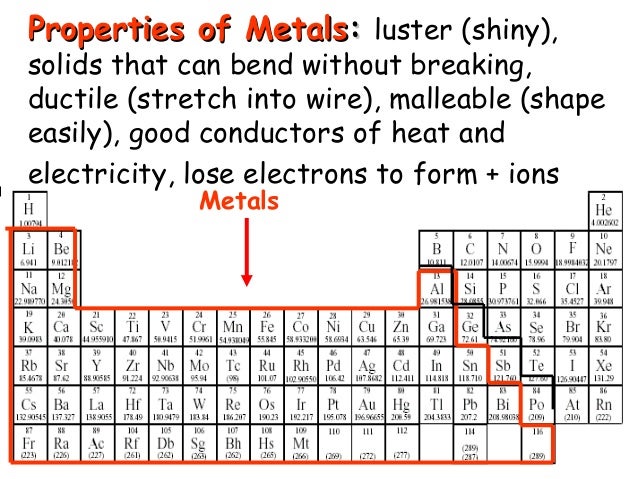
On the periodic table, metals are found to the left of the “staircase” that is located within the p-block. Luster is a property of metals, which is another way of saying that metals are shiny. Metals are able to bend without breaking. Metals are ductile, which means they can be stretched into a wire. Metals are good conductors of heat and electricity. Metals become cations, or positively charged ions, because they tend to lose electrons. Finally, metals are malleable, which means they can be shaped easily.


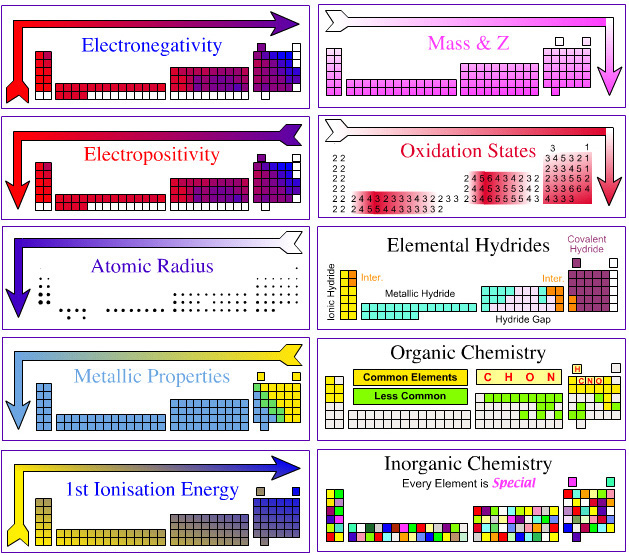
Trends of elemental properties can be found on the periodic table. One such trend is that of metallic properties. Metallic properties increase as one moves to the left and down on the periodic table. Iron and chromium are located within the same period on the periodic table. However, iron is to the left of chromium. Therefore, iron would manifest stronger metallic properties than chromium. Following such reasoning, iron would be more malleable than chromium. In fact, iron is one of the most malleable metals.

Miss Maudie tells Scout that “Mr. Radley was a foot-washing Baptist,” and goes on to say that some men worry so much about “the next world”...

Miss Maudie is suggesting that Mr. Radley's strict interpretation of the Bible had influenced the way he treated his son, Boo. Mr. Radley, who was a "foot-washing Baptist," believed that any type of pleasure was a sin. Mr. Radley kept Boo secluded inside the house as an extreme form of punishment for his youthful pranks. The "foot-washing Baptists" are so extreme in their beliefs that they view gardening as a sin. Mr. Radley's treatment of Boo seems inhumane, but to Mr. Radley his actions were justified.


In my opinion, I do feel that Mr. Radley was a Christian. I feel that he was trying his best to keep his son from getting into more trouble. If one were to take the Bible literally, they would immediately become an outcast in society, much like Mr. Radley. In Luke 18:22, Jesus says, "sell all that thou hast, and distribute unto the poor, and thou shalt have treasure in heaven: and come, follow me." Out of all the Christians I've met throughout my life, I have never met one that has sold "everything" they owned and given it to the poor. Mr. Radley's views would be in alignment with this verse, and he would be an outcast if he followed Jesus' directive exactly. Studying hermeneutics is difficult because there are so many different ways to interpret the Bible. In the eyes of a liberal or moderate Christian, Mr. Radley is "not" following Christ's message, but a strict conservative would feel different.

Wednesday, October 27, 2010

Are there any character interactions in the novel, To Kill A Mockingbird, that strongly reveals or demonstrates racial discrimination?

There are several scenes throughout the novel To Kill a Mockingbird where characters racially discriminate against one another. One such scene takes place at First Purchase African M.E. Church. When Calpurnia decides to take Jem and Scout to her African American church, the first person they interact with is a church member named Lula. Lula is ornery and views Calpurnia with contempt for bringing the Finch children to their church. Lula says to Calpurnia,


"You ain't got no business bringin' white chillun here---they got their church, we got our'n. It is our church, ain't it, Miss Cal?" (Lee 158)


Jem tells Calpurnia that they should leave because they don't want them at their church, but Calpurnia insists they stay. Lula is racially discriminating against Jem and Scout because they are white children in a black church. During the 1930's, Jim Crow laws prevented African Americans and white people from occupying and using the same public facilities. Segregation was commonplace, and Lula noticed that white children were in the "wrong" place. Her attitude toward the Finch children expresses her displeasure with the white community and the system of segregation. Typically, it is white people who complain about African Americans occupying their facilities, but in this case, it is white children who trespass into the black community's church. Lula is quick to chastise Calpurnia for bringing Jem and Scout and makes the children feel awkward and unwelcome in doing so.

What are some quotes on courage in the novel To Kill a Mockingbird?

In Chapter 9, Scout asks her father if he defends "niggers." Atticus admits that he does and tells her that he wouldn't be able to hold his head up in town if he didn't. He tells her not to let people "get her goat," and to remain calm when provoked. Scout asks Atticus if they are going to win and he tells her "no." Scout wonders why he's going to continue with the case, and he says,


"Simply because we were licked a hundred years before we started is no reason for us not to try to win." (Lee 101)


Atticus understands that he is taking on a highly sensitive case that he will more than likely lose. Atticus knows that real courage is facing adversity head on, despite its challenges. He will remain courageous and display his integrity as a morally upright man by defending Tom Robinson in a prejudiced courtroom later on in the novel.


In Chapter 11, Atticus makes Jem read to Mrs. Dubose after Jem loses his temper and destroys her camellia bush. At the end of the chapter, Mrs. Dubose passes away. Atticus explains to his children that Mrs. Dubose was suffering from a chronic disease and was addicted to morphine. Mrs. Dubose knew she was going to die, but wanted to break her morphine addiction before she passed away. Jem's reading distracted her for increasingly longer periods of time in between her morphine doses until she was finally able to break her addiction. Atticus comments that she was the bravest person he ever met. He says,


"I wanted you to see something about her--I wanted you to see what real courage is, instead of getting the idea that courage is a man with a gun in his hand. It's when you know you're licked before you begin but you begin anyway and you see it through no matter what. You rarely win, but sometimes you do." (Lee 149)


Tuesday, October 26, 2010

In the book The Boy in the Striped Pajamas, Pavel reveals something about himself that Bruno finds truly astonishing. What is this piece of...

After making a swing out of a tire and some rope, Bruno swings too high and falls out of the tire.  Pavel scoops him up and carries him to the kitchen for some first aid.  Naturally, Bruno wants his mother, but Pavel tells him that his mother hasn’t returned, so he will have to bandage the leg.  Bruno is really concerned.


Pavel washes the cut and assures Bruno that


“It won’t even need stitches.” (pg 80)


After he bandages the leg, he tells Bruno to sit for a while and rest the leg.  Bruno starts asking questions of Pavel.  Bruno thinks he may still have to go to the doctor, but Pavel says that will not be necessary.  Bruno says,


“How do you know? ... You’re not a doctor.” (pg 82)


That is when Pavel astonishes Bruno with the information that he is, indeed, a doctor.  Bruno doesn’t understand why a doctor would clean carrots and wait tables for the Commandant. 


The reader never totally finds out any more about Pavel.  He came from Poland and was a doctor in that country.  We learn from Shmuel that when the Germans invaded that country, they arrested all the Polish Jews and brought them to the prison camp by train.  It can be inferred that Pavel arrived the same way. When Bruno asks him when he arrived at “Out-With”, Pavel responds,


“I think I’ve always been here.”  (pg 84)


Bruno misinterprets it to mean that he was born at Auschwitz.  Pavel means that it feels like forever since he left his homeland.  Later in the story, Bruno asks Maria if Pavel was a doctor.  Maria tells him,


“Pavel is not a doctor any more.... But he was.  In another life. Before he came here.” (pg 137)


After Bruno promises not to tell anyone, Maria shares the story of Pavel with him.  Again, the reader is not privy to that conversation.


Then Bruno asks Shmuel if he knows of Pavel since they live in the same encampment.  Shmuel tells Bruno,


“The soldiers don’t normally like people getting better. ...it usually works the other way round.” (pg 139)


That is the reason Pavel is not allowed to practice medicine in the encampment.

What quotes can be used to support the claim that Lady Macbeth is more ambitious than Macbeth?

You can find the best quotes for your project in Act 1, Scene 7 of Macbeth. In this scene, the husband and wife essentially have an argument in which Macbeth expresses all his doubts and misgivings about murdering King Duncan. Lady Macbeth overcomes all of his scruples because of her passionate desire to see the accomplishment of the violent act they have previously discussed. Shakespeare does not want Macbeth to be a pure villain like Richard III or Iago. The playwright wants the audience to feel some degree of sympathy for this man because it is supposed to be his tragedy. Shakespeare accomplishes this partly by showing Macbeth's strong misgivings in the soliloquy which opens Scene 7. Then the playwright passes on some of the guilt to Macbeth's wife for the sole purpose of making Macbeth look like a somewhat better man than the audience would take him to be if he had no doubts, scruples, misgivings, or apprehensions. The most significant lines in the scene are spoken by Macbeth when his wife intrudes on his meditations and he tells her:


We will proceed no further in this business:
He hath honor'd me of late, and I have bought
Golden opinions from all sorts of people,
Which would be worn now in their newest gloss,
Not cast aside so soon.


He is saying, in effect, that he can be content with what he has already achieved and doesn't really want to be king. He is Thane of Glamis and Thane of Cawdor. He is loved by King Duncan and honored and admired by everybody because of his leadership in the recent war. He is trying to assert his authority as the lord and master in the marital relationship. But we can sense that he is acting more confident than he really feels. His wife shows that her ambition is greater than his by giving him a tongue-lashing in which she uses every rhetorical device at her command. She is using "sexual blackmail" when she suggests that she cannot believe her really loves her if he is disappointing her after building up her hopes that she might become queen.


Was the hope drunk
Wherein you dress'd yourself? Hath it slept since?
And wakes it now, to look so green and pale
At what it did so freely? From this time
Such I account thy love. Art thou afeard
To be the same in thine own act and valor
As thou art in desire? 


She seems to be suggesting that she will lose all respect for him if he doesn't go through with the murder; and this will have a negative effect on their sexual relations. He has become dependent on her love and is persuaded that he has to do what she wishes in order to retain her affection. It is questionable whether she really loves him at all. She does not seem like a loving person. But she is the woman he is married to. He loves her deeply, regardless of whether she loves him or not.


At the end of the scene, Macbeth is entirely compliant and submissive. He speaks the final lines:


I am settled, and bend up
Each corporal agent to this terrible feat.
Away, and mock the time with fairest show:
False face must hide what the false heart doth know.


It seems obvious that Macbeth would never have murdered King Duncan if it hadn't been for the influence of his wife. She is inflexible in her determination to become queen, whereas his vacillation shows that he does not really care all that much about becoming king. He is right, of course. He has risen far enough in life. He is not qualified to be a good monarch. He shows this throughout the rest of the play in the way his misrule brings Scotland to ruin. 


There is no better scene than Act 1, Scene 7 to contrast Macbeth and his wife in the relative strength of their ambitions. This is where they both "have it out" and reveal themselves to each other and to the audience.

Monday, October 25, 2010

What, according to Marx, is the relationship between economic systems and culture? How might this relationship relate to the arts?

For Karl Marx, everything is determined by what he calls the mode of production, or the social relationships by which goods are produced for society.  This mode of thinking is sometimes called economic determinism, seeing the economic sphere--and its corresponding mode of production--as determining everything else in any given social arrangement, from politics to art.  Thus, art, for Marx, is an expression of the material economic relationships out of which it was produced.  In the Grundrisse's introduction he asks rhetorically,


is Achilles possible with powder and lead? Or the Iliad with the printing press, not to mention the printing machine? Do not the song and the saga and the muse necessarily come to an end with the printer's bar, hence do not the necessary conditions of epic poetry vanish?


In this brief series of questions, Marx implies that classical Greek epic--here represented by Homer's Iliad--requires a certain mode of production that does not include technologies such as powder, lead, and the printing press.  Thus, all (good) art for Marx requires that the artist express the material conditions of the age in which the artist produces the work.  As he implies, all artworks depend in their form upon certain necessary conditions which are inherently bound up with technological advancements and the mode of production.

Sunday, October 24, 2010

What is the basic unit of all living organisms?

The basic unit of all living organisms is cell, according to the cell theory. The simplest living organisms are the single celled organisms, also known as prokaryotes (such as bacteria, etc.). Higher life forms (such as plants, animals, human beings, etc.) are made up of many cells and are multi-cellular organisms, also known as eukaryotes. Thus, cell is the fundamental unit of life and hence cannot be further sub-divided. Also, cells only originate from pre-existing cells. 


Prokaryotes carry out all their functions using a single cell, however, eukaryotes requires much more complex systems. Cells that carry out similar functions are grouped as tissue. Tissues with similar functionalities form an organ and a number of organs working for the same goal constitute an organ system. For example, circulatory system is an organ system, heart is an organ and nerve tissues are made up of nerve cells, etc. 


Hope this helps. 

What is personification and how is it used in "The Tell-Tale Heart"?

The literary device personification is when a writer gives typically human characteristics to non-human animals or objects. For example, describing a "furious thunderstorm" would be personification, because the phrase suggests that the thunderstorm has human emotions and can feel fury. 


Abstract ideas are often personified as well. For example, the concept of death or dying is often seen in literature as a human figure in a long, black, hooded cloak, carrying a scythe.  


The most important example of personification in the short story "The Tell-Tale Heart" is the personification of the old man's "evil eye." Though the narrator never describes the eye as having a human form or doing human things, he does see it as a separate being from the old man himself. The narrator says,


"it was not the old man I felt I had to kill; it was the eye, his Evil Eye" (paragraph 5).


This quote shows that the narrator sees the eye as having some kind of sinister purpose, separate from the old man, whom the narrator claims to love and sees as an innocent bystander to the eye's evil.

The narrator elaborates further on the evil quality of the eye, comparing it to, 


"the eye of one of those terrible birds that watch and wait while an animal dies, and then fall upon the dead body and pull it to pieces to eat it" (paragraph 3). 


Clearly, the narrator sees the eye as capable of great evil and perhaps even thinks it intends to harm him - two things that only humans are capable of plotting to do. 

Saturday, October 23, 2010

Do you think the speaker loves her husband as much as she says does?

Literary scholars have always professed that Anne Bradstreet did not originally intend for her poetry to be published. While she was an educated woman and wrote poetry for her father growing up, she understood where women writers stood in Puritan society. Thus, when reading "To My Dear and Loving Husband," the reader does not doubt that Bradstreet certainly felt the level of love that she writes about.


We study Anne Bradstreet's poetry because it gives the modern reader the feeling that human emotions have not changed over time—people still feel love, hate, despair, sorrow, etc. Thus, the Puritans were very much like the rest of us. However, the published texts of the time, historical and theological pieces, only give the view that Puritans wanted to give. They wanted to be seen as John Winthrop's "city upon a hill." Anne Bradstreet shows us that she loved her husband beyond what the church would have deemed necessary, but she was human after all.

I need a summary of "The Road Not Taken" by Robert Frost, highlighting important points.

"The Road Not Taken" by Robert Frost is a poem consisting of four five-line stanzas. The basic meter of the poem is iambic tetrameter, with frequent anapestic substitutions. The rhyme scheme is ABAAB.


The poem is told in the past tense by a first-person narrator. The narrator is traveling through the New England woods in the fall, when the leaves are yellow. He stops at a spot where the road forks and looks at two possible roads he could take forward. 


Neither road has been traveled lately, as the leaves on both of them are yellow and freshly fallen, not black as they would have been had someone stepped on them. One road is slightly more overgrown with grass and thus less frequently traveled; the narrator chooses that path.


The final stanza reflects back on the significance of this choice. The narrator says: 


Two roads diverged in a wood, and I—


I took the one less traveled by,


And that has made all the difference.


This ending suggests that the narrator is reflecting not just about the roads but about the life choices we make. Even though, as with the roads, many life choices don't appear that different or radically important at the time we make them, they turn out, when seen with hindsight, to have had momentous consequences. 

Friday, October 22, 2010

What is the point of view in "The Hobbit"?

The point of view in The Hobbit is the third person point of view, meaning that the story is told with words such as "he", "she", "it", and "they" (rather than words such as "I" or "me", which are the first person point of view, or "you" which is indicative of the second person point of view). The Hobbit is told through an omniscient, or all knowing, narrator, who occasionally slips into the first person to comment on the story. One instance of that can be seen at the very beginning of the story: "I suppose hobbits need some description nowadays...", though there are many examples of the narrator doing things like this. Aside from that, the narration mostly sticks to Bilbo, occasionally branching out to other characters for very short periods of time, such as when Gollum is introduced in the chapter "Riddles in the Dark".

How did Aaron Burr first anger Alexander Hamilton ?

Long before their duel in July of 1804, which left Hamilton with wounds that would kill him, Hamilton and Burr had been rivals. Their initial disagreement arose from a 1791 U.S. Senate race in which Burr defeated Philip Schuyler, who was Hamilton's father-in-law. Hamilton, then Secretary of the Treasury, was relying on his father-in-law's support for his fiscal program, which was in support of Federalist policies. Burr, on the other hand, was an anti-Federalist (later a Democratic-Republican, called Republicans for short).


In 1800, Burr published a tract Hamilton had written to privately criticize John Adams, then the President. Burr's publication of this document embarrassed the Federalist party. The rift between Burr and Hamilton widened with the election of 1800, in which Burr and Thomas Jefferson deadlocked. Hamilton threw his support behind Jefferson in the House of Representatives (which had to decide the election), who wound up becoming President. Burr became the Vice President under Jefferson. Finally, in the election of 1804 for Governor of New York, Hamilton again opposed Burr's campaign, and Burr wound up losing the election. The event that precipitated their duel was a remark that Hamilton made at a social event about Burr; the remark, made in 1804, had to do with Burr's personal character.


Burr and Hamilton met in a duel in Weehawken, New Jersey, on July 11, 1804. They had dueled with other people before. Each fired shots from their pistols; Burr was not harmed, but Hamilton was hit and died the day afterward. Burr, who was indicted but later acquitted on charges of murder, was hoping to revive his political career with the duel; however, the duel effectively ended his career. 

Thursday, October 21, 2010

What do Shakespeare's plays tell us about his view of the world?

This question likely has an infinite number of answers, as Shakespeare's plays propose a variety of different interpretations of the world. Some plays (the comedies) are more uplifting, while others (the tragedies) offer a truly gloomy world view. It helps to look at a few plays in each category to understand the different ways Shakespeare developed a philosophical expression of human existence.


In A Midsummer Night's Dream, Shakespeare creates a mystical, fanciful, comedic, and overall magical environment. His vision of Ancient Greece is populated by mischievous fairies, witless actors, and hapless lovers. It's impossible to leave a production of this play without a considerably improved attitude, as its hilarious story has a happy resolution in which all the main characters live happily ever after. All in all, in a Midsummer Night's Dream Shakespeare conceives of a dreamlike world governed by magical fairies and comedic good fortune. 


The tragedies, on the other hand, present a very different worldview. King Lear, for instance, suggests that humans live in a world devoid of God or destinies. Lear often rails against the unfeeling cruelty of nature, despairing at the overall lack of meaning in life. In contrast to comedies like DreamLear suggests that existence is ultimately meaningless and bleak, and that humans live in a world in which happy endings are a fairy tale, rather than reality. 

Does Frome make a strong defense for Falder in Justice by John Galsworthy?

Frome does mount a very strong defense for Falder in the play. His speech is often cited for its eloquence, and for its historically important espousing of empathetic legal treatment for a man whose guilt is not in question. It's important to note that the play was written in Britain in 1910, a time and place where very harsh judicial punishment was common. 


Galsworthy was an influential critic of the contemporary British justice system, specifically the conditions in prisons. He was one of the first intellectuals to posit that prison will turn someone who simply made a mistake into a hardened criminal. This view is vociferously expressed by Frome in his arguments for Falder. Unfortunately, the argument is unsuccessful and Falder is sent to prison. 

What is the doleful sight of which Mary Rownlandson writes?

Mary Rowlandson, a 17th-century Massachusetts colonist, became entangled in King Philip's War, which was a war between Native Americans and British colonists. She, along with her children, was captured by Native Americans and held prisoner for ransom. Thankfully, her life was preserved; however, many of her family members and friends were killed. She documented the ordeal in what is considered one of the first great "captivity narratives."


Early in A Narrative of the Captivity and Restoration of Mrs. Mary Rowlandson, the author refers to a "doleful sight that now was to behold at this house!" The word "doleful" means "mournful," so by this she meant that her family's house was about to witness the tragic events depicted in her captivity narrative. As she relates:


Of thirty-seven persons who were in this one house, none escaped either present death, or a bitter captivity, save only one, who might say as he, "And I only am escaped alone to tell the News" (Job 1.15). 


She then describes the "doleful sight."


There were twelve killed, some shot, some stabbed with their spears, some knocked down with their hatchets....There was one who was chopped into the head with a hatchet, and stripped naked, and yet was crawling up and down. It is a solemn sight to see so many Christians lying in their blood[.]


This scene was indeed tragic! Nevertheless, Rowlandson found hope in this doleful situation, for:


[T]he Lord by His almighty power preserved a number of us from death, for there were twenty-four of us taken alive and carried captive.


How does Shakespeare use dramatic irony to show that Romeo and Juliet's love is doomed or finished in Act II, Scene 2 and Act III, scene 4?

Dramatic irony occurs when the audience knows something that a character(s) doesn't know. There are several instances of dramatic irony in Shakespeare's Romeo and Juliet. For almost the entire play, the love between the two young people is known only by two other people. The majority of the characters are not aware of what is really going on, and this proves to be a problem.  


Act II, Scene 2 is the balcony scene, one of drama's most famous scenes. Romeo steals into the Capulet orchard to catch another glimpse of Juliet. He fell madly in love with her at the party earlier in the evening. The audience knows that Romeo is below the balcony, but Juliet does not as she utters the famous lines,


O Romeo, Romeo, wherefore art thou Romeo?
Deny thy father and refuse thy name,
Or, if thou wilt not, be but sworn my love,
And I’ll no longer be a Capulet.


In these lines she sums up the main conflict in the play. The Montagues and Capulets are bitter enemies and the only way the love between the two will succeed is if they "deny" who they are. Since they cannot escape their identities their "forbidden" love is doomed.


Act III, Scene 4 is one of the best examples of dramatic irony in the play. After the death of Tybalt, Lord Capulet is looking for a "day of joy" so he goes back on his earlier ideas about Juliet marrying Paris and promises his daughter to the Count. It is particularly ironic because while he is arranging a wedding for Juliet, she is in her bedroom with Romeo. The two have been joined by Friar Lawrence earlier in the day and are consummating the marriage. Neither Lord Capulet, his wife, or Paris have any idea. The arranged marriage with Paris greatly contributes to the ultimate tragedy. After the Nurse advises Juliet to forget Romeo and marry Paris, she becomes desperate and agrees to the Friar's unfortunate plan for her to fake death.  

Wednesday, October 20, 2010

How did Progressivism result in America justifying empire building?

One of the great ideals of Progressivism was that its founders knew what was best for people and if they only followed the Progressive way, society would be cured of its ills.  Food would be safer.  Families would be free from alcoholism.  Children would learn.  The imperialistic mood of the late 1800s and early 1900s reflects this.  America thought that it knew what was best for the people of the Spanish Empire and the Pacific.  It would be hard to justify to the American people that we invaded Cuba in order to protect our sugar interests, so the government kept tying the war to humanitarian reasons.  Also, America had a right to intervene anytime the government was unstable; of course, this was interpreted as America could intervene anytime the government was not friendly to it.  This was especially true in the Filipino insurrection that took place after the Spanish-American War.  With the help of Emilio Aguinaldo, America defeated the Spanish garrisons on the Philippine Islands.  Aguinaldo thought that he should be in charge of the country, but American idealists thought that the people of the Philippines were not ready for self-government.  This sparked the Filipino Insurrection which killed more people than the Spanish-American War.  Progressivism led to many valuable changes domestically for America, but the people it affected internationally thought American actions were too high-handed.  

Why does the boy tell his father to leave the sickroom in "A Day's Wait"?

In the story, the boy has a seemingly cryptic conversation with his father about leaving the sickroom.


After a while he said to me, “You don’t have to stay in here with me, Papa, if it bothers you.” “It doesn’t bother me.” “No, I mean you don’t have to stay if it’s going to bother you."


When the doctor tells him that his temperature is a hundred and two, the little boy, Schatz, thinks that he is going to die.


"People don’t die with a fever of one hundred and two. That’s a silly way to talk.” “I know they do. At school in France the boys told me you can’t live with forty-four degrees. I’ve got a hundred and two.” He had been waiting to die all day, ever since nine o’clock in the morning.


The boy's fears come about because he does not realize that there is a difference between temperature measurements in Celsius and in Fahrenheit. Once his father corrects his assumptions, Schatz relaxes enough to be able to give vent to his emotions. The dialogue suggests that Schatz asked his father to leave the sickroom because he doesn't want his father to get sick; also, in asking his father to leave, Schatz may have thought that he was sparing his father the grief of watching his son die.

Monday, October 18, 2010

What event affected Mr. White's personality and behavior?

Belief in the paw undoubtedly shaped Mr. White's behavior. 


In the beginning of the story, Mr. White takes a chance and makes a wish.  At the bidding of his son, who is skeptical about the paw, Mr. White asks for two hundred pounds, which is what he needs to pay off his house.  After the does this, he thinks that the paw moves.  He begins to be afraid.  Later that night, he thinks he sees a monkey's face in the fire.  He ignores these events and goes to bed.  A few days later, he gets a visit from Herbert's employers, and they say that Herbert died in an accident.  The employers also give two hundred pounds. Mr. White begins to believe that the paw did this.  Later at the bidding of his wife, he wishes for this son to be alive. 


After he does this, he hears a knock on the door.  He knows it is Herbert.  In a panic he wishes that it goes away.  


In light of these events, Mr. White is a changed man.  He believes in the power of the paw.  He realizes that he cannot tamper with fate.  This is exactly what Sergeant Major Morris said in the beginning of the story.


An old fakir put a spell on it. He was a very holy man and he wanted to show that fate ruled people’s lives, and that to interfere with fate only caused deep sadness.


Sunday, October 17, 2010

Why did the economy in the South rely on slave labor?

There are reasons why the economy in the South relied on slave labor. The South was mainly an agricultural region. The climate was very suited for farming, and the soil was very fertile. As farming grew in the South, southern farmers brought in slaves to do the work. An important factor in this development was the invention of the cotton gin.


Before the cotton gin was invented, most cotton was grown near the coast. This long-staple cotton was a profitable crop, and the seeds could easily be separated by machine. The short-staple cotton crop was grown inland, and the seeds had to be separated by hand. Once the cotton gin was invented, cotton could be grown anywhere, and the seeds could be separated by using machines. This led to an explosion in cotton growing in the South, as plenty of lands was available for growing cotton. This led to an increased demand for slaves. Growing cotton was very profitable, as southern cotton was in big demand in Europe. The southerners believed their economy could not survive without slaves. They believed there would be a collapse of their economy if slavery ended. As a result, southerners fiercely fought to maintain slavery and to work for the spread of it to other regions where farming was done.

What contributes to the mass of a plant?

Mass refers to how much matter is contained within an object. Matter takes up space and is composed of different elements. Mass is measured in kilograms. Weight can be the measurement used for mass, however, this depends on the gravitational pull on the object being measured and it would vary if the weight was measured on another planet with a different gravitational pull.


If one wishes to determine what makes up the mass of a plant, the matter within it needs to be analyzed to determine the elements that make up a plant.


The main chemical elements in all living matter are carbon, hydrogen, oxygen and nitrogen which comprise 96% of their make up. The remaining 4% includes phosphorus, calcium, sulfur, and potassium, along with other trace elements found in very minute quantities.


Plants contain macromolecules such as proteins, lipids and carbohydrates (sugar, starch and the structural carbohydrate cellulose in their cell walls). Plants also contain nucleic acids like DNA and RNA and these are organic compounds made of atoms of carbon, hydrogen, oxygen and nitrogen. Plants also store large quantities of water in their central vacuoles within their cells. In fact, their cells are mainly water. Water is made of hydrogen and oxygen atoms. The water in plants makes up the largest contribution to its mass.


Therefore, the structural parts of plants contain the elements described as well as the large amount of water present in their cells. These atoms contribute to the mass of a plant.

Saturday, October 16, 2010

Have law enforcement capabilities been hindered or improved because of the implementation of U.S. fusion centers?

The US Department of Homeland Security's (the "DHS") website explains that Fusion Centers are "state and major urban area focal points for the receipt, analysis, gathering, and sharing of threat-related information between federal, state, local, tribal, territorial..., and private sector partners".  Stated more succinctly, Fusion Centers are clearinghouses for the sharing of criminal or terrorist threats to local, state, or national security. Prior to the September 11 terrorist attacks on US soil, no mechanisms had been erected to compile and share this type of information among law enforcement organizations.


Notwithstanding the well-intentioned and lofty goals that the Fusion Centers reflect, they have been generally ineffective in advancing law enforcement capabilities. The DHS can claim that its systems have prevented further criminal activity and terrorist attacks, but those systems have not eradicated that activity or those attacks completely. 


The greatest drawback of Fusion Centers is that the amount of information that they accumulate is beyond the processing capabilities of the staff and equipment dedicated to those centers. Noise in the system easily overwhelms the signal. 


Further, the supposed sophistication of Fusion Centers eclipses traditional police work that is based on experience and instinct. Seasoned law enforcement investigators rely on sources and field experience that can take years to develop. Fusion Centers attempt to replace this experience with an unfiltered volume of information with no ability to distinguish the relative importance of one piece of information over another.


Fusion Centers embody one of the more troublesome features of the modern electronic age; namely, they focus on data gathering over data analysis. Judgment and insight take a backseat to the technical capabilities of a Fusion Center that can intercept phone calls and collect massive amounts of video surveillance. Experience-based law enforcement that emphasizes analysis will generate better results.

Friday, October 15, 2010

What is the political point of view and argument of "War is Kind" by Stephen Crane?

In his poem "War is Kind," Stephen Crane takes an ironic point of view toward war in order to make his contradictory argument about the kindness of war.

Not only is there irony, but there is a bitter tone to this poem, especially in certain lines, such as the following:


Do not weep, babe,...
Because your father tumbled in the yellow trenches,
Raged at his breast, gulped and died.


The contradictory argument, the irony, here is that the father dies a terrible death and leaves the child, but somehow "war is kind." 

In the next stanza, the glorious symbol of war and courage, the eagle "with crest of red and gold," has been made a mockery by the dead soldier who falls into these "yellow trenches." So there is more irony as the glorious colors have deteriorated to yellow. 

Further, Crane points to the cruelty and futility of war that leaves children without fathers, mothers without sons, women without their lovers or husbands. Also, he points to the false patriotism--"Great is the Battle Guard"--that would make men believe that they are performing heroic deeds for their country, deeds for which mothers should be willing to sacrifice their sons for "the virtue of slaughter":


Mother whose heart hung ...
On the bright splendid shroud of your son,
So not weep.
War is kind.


Thursday, October 14, 2010

Why was the Cold War called the Cold War?

A cold war is a term used to describe a period of time when there are confrontations and competitions between countries. After World War II, the United States and the Soviet Union had a series of competitions and confrontations.


The Soviet Union wanted to spread communism throughout the world. In a communist system, there is a great deal of government control. In our system, there is much less government control and influence.


The United States wanted to give aid to countries that were resisting the spread of communism. The European Recovery Program offered economic aid to countries. We believed that if a country had a strong economy, it would be less likely to turn to communism. For example, we gave aid to Greece and Turkey. Those countries didn’t become communist. Our goal was to keep communism where it was and not let it spread. This was the basis of the policy called containment.


We also helped countries militarily when a communist country attacked them. For example, when communist North Korea, supported by the Soviet Union, invaded South Korea, we went to the United Nations to provide help to South Korea. The United Nations created a multinational military force, led by the United States, to remove North Korea from South Korea.


We also competed with the Soviet Union. Both countries tried to develop nuclear weapons. While the United States was the first to develop the atomic bomb, the Soviet Union eventually developed its own atomic bomb. Both countries also competed in the space race. While the Soviet Union was the first country to get a satellite into space as well as the first to get an astronaut into orbit around the earth, we were the first country to land an astronaut on the moon.


The United States and the Soviet Union had a period of confrontations and competitions after World War II. While both countries didn’t directly fight each other, they were working against each other in many ways.

In what ways was the Bull Moose party different from the Republican Party of its time?

The Bull Moose, or "Progressive" Party is sometimes held up as an example of a "bolter" party, i.e., one that leaves a major party to field candidates on its own. The Bull Moose Party was formed when Theodore Roosevelt left the Republicans in advance of the 1912 presidential election. Essentially, he claimed that William Howard Taft, the Republican nominee, had backtracked on the Progressive agenda that Roosevelt had brought to the White House. The Bull Moose Party thus differed from the Republicans in that they embraced far more reforms than the more conservative (but not entirely reform-averse) Republicans under Taft. Roosevelt's platform, often called the "New Nationalism," was for its time one of the more radical political positions ever taken by a Presidential candidate. It called for strict regulation of the trusts, woman suffrage, outlawing child labor, an eight-hour workday, currency reform, an income tax, and for transparency in investments, among many other initiatives. Most of these reforms were anathema to the Republicans, who embraced only limited regulations on the economy.

Wednesday, October 13, 2010

Why is Okonkwo so fearless in the face of death?

In Chinua Achebe's debut novel Things Fall Apart, the protagonist Okonkwo is presented as a strong warrior who is occupied with living up to his own lofty masculine standards of success and fulfillment. Part of his masculine posturing manifests itself in his outwardly courageous, warrior nature. He is determined to be an effective warrior, and this determination makes him unafraid to fight and be destructive. While Okonkwo is in fact fearless in the face of potential death, I argue that he is not as brave as he would have his peers believe that he is. Indeed, Okonkwo is incredibly self-conscious about how he is perceived in the Igbo society. He works hard to fit into his own narrow definition of "manliness," and he is scared of being perceived as weak or feminine. So while he is fearless in many respects, he is ultimately afraid of being weak, and this, in part, leads to his downfall.

Analyze to what extent different colonized societies resisted imperialist efforts and how successful were their actions? (1850-1914)

Between 1850-1914, different groups of people resisted being colonized. The results were mixed regarding their success.


The people of the Philippines were very unhappy with the Spanish rule. When the Spanish were defeated in the Spanish-American War, the people of the Philippines thought they might get their independence. They weren’t pleased when the United States came to the Philippines and began to rule them. The people revolted, but the revolt was unsuccessful. The people of Philippines didn’t get their independence until 1946.


The people of the Balkans weren’t pleased they were being ruled by people who were of a different nationality than they were. This dissatisfaction led to the development of a plot to kill the next King of the Austro-Hungarian Empire, Franz Ferdinand. It was his assassination by a group of Serbian nationals that led to the start of World War I. At the end of World War I, many new countries were created based on the concept of self-determination, meaning people would be ruled by their own ethnic group. This led to the breakup of the Austro-Hungarian, German, and Ottoman Empires.


The people of Alsace and Lorraine weren’t pleased they had been taken over by Germany in 1871. They didn’t support German rule, and when World War I ended, these provinces were returned to France.


The people of Latin America were not pleased with American involvement in their countries. While these countries remained independent, the Americans intervened many times, often to protect American investments and to keep pro-American governments in power. These countries resented our constant interference in their affairs. This resentment still exists to some degree today.


The Cubans weren't happy with the rule of the Spanish. The Spanish treated the Cubans poorly. The Cubans revolted, and with help from the United States, they got their independence. While there were some strings attached to Cuban independence by the Platt Amendment, which gave the United States the right to intervene in Cuba, Cuba did gets its independence from Spain. The Cubans weren't thrilled with Platt Amendment, but they accept it to get the United States military to leave Cuba.


There were varying degrees of success for countries trying to free themselves from colonial rule or from foreign intervention  between 1850-1914.

In Macbeth, what is the significance of the quote by Macbeth to Banquo in Act III in which Macbeth says, "We hear our bloody cousins are bestowed /...

Macbeth is telling Banquo that Malcolm and Donalbain are not admitting to Duncan’s murder.  The speech is foreshadowing Banquo’s death and Malcolm’s return.


When Macbeth killed Duncan so that he could become king, it was important that he also get the king’s two sons out of the way.  In order to do this, he framed Malcolm and Donalbain for the king’s death.  It was not hard for people to believe that one or both of them killed their father, because Duncan had just named Malcolm his heir.


It is important to Macbeth that Banquo not suspect him.  He wants to make sure that Banquo thinks that Malcolm and Donalbain are the real murderers.  In this scene, he is talking to Banquo just before he is supposed to be killed by Macbeth’s three murderers.  


Banquo is indeed suspicious of Macbeth.  He knows about the witches’ prophecies and he even heard one suggesting that his sons would be king.  Not soon after that, Duncan is killed.  Yes, anyone would be suspicious and worry that he would be the next target. 


Thou hast it now: king, Cawdor, Glamis, all,
As the weird women promised, and, I fear,
Thou play'dst most foully for't: yet it was said
It should not stand in thy posterity,
But that myself should be the root and father
Of many kings. (Act 3, Scene 1) 


Macbeth wants to make sure that Baquo has no suspicions in this speech.  He himself is worried that Banquo knows too much, and is also annoyed at the prophecy that Banquo’s sons would be king.  Before Banquo can get any ideas, he has to dispatch him.


To be thus is nothing;
But to be safely thus.--Our fears in Banquo
Stick deep; and in his royalty of nature
Reigns that which would be fear'd: 'tis much he dares;
And, to that dauntless temper of his mind,
He hath a wisdom that doth guide his valour
To act in safety. (Act 3, Scene 1)


There is a nice parallelism to these two soliloquies.  Banquo is thinking to himself that he worries that Macbeth killed Duncan, and Macbeth is thinking to himself that he is worried that Banquo thinks that he killed Duncan.  Neither of these speeches is good news for Banquo.  Macbeth is suspicious of him, and Macbeth has the will to act, and fast.


Macbeth’s speech about Malcolm and Donlbain is supposed to allay Banquo’s suspicions long enough for him to be killed, but it also foreshadows, or hints at, Banquo’s death and Malcolm’s return.  By mentioning Malcolm to Banquo, Macbeth reminds us of his former murder.  The comment about Malcolm not confessing gives us insight into Malcolm’s true character as well and foreshadows his return.  Malcolm may have run away, but only long enough to form an army he can use to storm Macbeth's castle and get revenge on his father’s murderer so that he can take bath the throne that should be his.

Tuesday, October 12, 2010

How can I approach an essay about the meaning of friendship?

Friendship may mean different things to different people. Further, we likely have different reasons at different periods in our life for forming friendships.


We may form friendships for solidarity in achieving shared objectives and overcoming shared challenges (as in school or work), as well as for emotional support in our daily lives. Some friendships may be limited in scope, whereas others are parts of many or all aspects of our lives. And some friendships may be of limited duration while others last a lifetime.


Regardless of the reason for forming friendships, the impetus for them is usually some commonality of experience. This differs from our relationships with our family members in many respects as family relationships exist independent of active choice, whereas we choose our friendships. Further, family members may also share a friendship that is apart from their family relationship. This would happen, just like non-familial friendships, when two people have shared experiences and interests.


Another way of looking at friendship is that our friends are the people whom we want to be around even when we are troubled. We find in them emotional support that is different from what we may obtain from our families. They are the people we choose to spend our time with because so doing makes us happier, or at the least more at ease.


Finally, we may also look at friendship as being those people whom we love by choice. We love such people not because we are supposed to love them on account of familial and societal constructs, but for who they are and how we feel when we are around them.


As Louie Armstrong sang in “What a Wonderful World” (written by Bob Thiele and George Weiss):


I see friends shakin' hands


Sayin', "How do you do?"


They're really sayin'


"I love you."


At the beginning of the story, what natural disaster has occurred? Why does Rolfe Carlé end up at the scene of the disaster?

“And of Clay Are We Created” is a story told in the aftermath of the 1985 Nevado del Ruiz volcanic eruption in northern Colombia.  The eruption triggered avalanches in the higher reaches of the mountains, and all the falling snow mixed with earthen debris to disastrous effect.  Allende powerfully describes it as


that fateful Wednesday night in November, when a prolonged roar announced the end of the world, and walls of snow broke loose, rolling in an avalanche of clay, stones, and water that descended on the villages and buried them beneath unfathomable meters of telluric vomit.  


So what we’re dealing with here is a volcanic eruption triggering avalanches, which led to devastating mudslides. 


Rolf Carlé ends up at the scene because he is a prominent television news reporter.  This status allows him helicopter access to the remote location of the disaster, and puts him first on the scene when the print journalists are trying to fight the elements to arrive by land.  The narrator says of Carlé:  “For years he had been a familiar figure in newscasts, reporting live at the scene of battles and catastrophes with awesome tenacity.”  He is therefore not only prominent, but also has years of disaster coverage on his resume.  This gives him senior access to the drama unfolding after the disaster – but of course he finds that this particular news story ends up affecting him far more than any he had covered before, in all those years of experience.

What dilemma does Lyddie face in Lyddie?

Lyddie faces many dilemmas throughout the story. I will try to pick a couple that are pivotal decisions for Lyddie.


One dilemma that Lyddie faces is going to work in the mills in the first place. She is stepping way out of her comfort zone and heading toward a completely unknown situation. She is a small town farm girl. The very notion of a big city and factory work is completely foreign to her. Despite the choice being scary, Lyddie chooses to go.  


Another dilemma that Lyddie has is to whether or not she should sign the petition for better working conditions. On the one hand, Lyddie knows that the girls are being worked ridiculously hard. Signing the petition might bring positive changes for the working girls. On the other hand, by signing the petition Lyddie risks being blacklisted from the mills completely. That means she won't be able to find work. No work, no paycheck; therefore, she won't attain the financial independence she so desperately craves.

Monday, October 11, 2010

When, by whom, and for what purpose was America's first college revived?

America's 1st College was originally founded by the historic first Virginia General Assembly, 31 July 1619, convened in the wooden Church on Jamestown Island. The Assembly wrote out "Petitions" requesting the Virginia Company Headquarters back in London to take specific actions. The "Fifte Petition: Please send workers able to construct the Colledge". This was over a year before the 1620 Mayflower Pilgrims sailed to "the northern parts of Virginia", settling in the area of Plimouth Rock. The 1619 college campus was to be located upriver from Jamestown, at the 1611 Citie of Henricus (just downriver from today's Richmond), and was being constructed when, on Good Friday 1622, the regional Powhatan Indians launched a suprise attack on the English settlements all along the James River, killing about 1/3 of the settlers and driving the others down river into conclaves of safety. Within a year the settlers launched a vigorous counter-attack, driving the Powhatans into the swamplands, and then resuming some construction on the colledge campus. However, next year, 1624, King James crushed the Virginia Company and declared the entire venture to now be under direct Royal control. Turmoil in England itself, including the English Civil War which at one point led to the abolition of the Monarchy, prevented any action again to build up the campus across the Atlantic over in wild Virginia for most of the rest of the 1600's. Finally, the Civil War issues were settled, and new joint-Monarchs were crowned in 1688, the vigorously Protestant King William and Queen Mary. The effort to have a Colledge in Virginia was resumed, the campus being relocated downriver at a site called "Middle Plantation" (soon to be designated as the city of Williamsburg), and renamed "Wm & Mary" in honor of new current Monarchs...the purpose being the same as the original Henricus Colledge, which is noted on a marble plaque at the Wren Building. Then, in very modern times, in 1992 (373-years after the original founding) America's 1st College was revived as "HENRICUS COLLEDGE (1619)r", purpose being "American Heritage Research and Continuing Education", focused on the "Lineage of Liberty Under Law". The name was registered in the U.S. Patent Office to Steven C. Smith, who serves as Chancellor of the Colledge still today, 2016. Website is www.firstcolledge.us. Plans are underway for the Colledge to have a 400th Anniversary Celebration in 2019.

What is the central message in The Giver?

Different people will probably take away different messages from The Giver.  I will share the one that I have gleaned, and perhaps others will share theirs, too. You will need to decide what messages you have absorbed from this story. 


The message that I take away is that it is only possible to have a completely safe society if we take away peoples' choices, individuality, and emotions.  These are what make us who we are, and it is a terrible tradeoff, in my opinion.  The people of the community do not get to choose their housing, their work, their spouses, or their children.  They must all even dress according to the rules.  Even what color ribbon a child wears is decided by the community, so there is absolutely no expression of individuality.  Emotions are repressed by medication, and so is sexual desire. All of this promotes the safety and productivity of the community, but the cost is too great for its denizens; they have given up their humanity for safety. 


I also think that this message has particular resonance in today's world, where people in some countries want to shut down their borders, spy on their populaces, and impose some sort of religious conformity, all in the interest of "national security."  There are no doubt some who think a dome, such as the dome that is in The Giver, would keep everyone safe. The message of the book is one that we should attend to, though, the idea that perfect safety comes at the cost of our own humanity. For me, that is too high of a price to pay. 

Sunday, October 10, 2010

How did the clash between traditionalist and modernist reveal itself in the Scopes Trial?

The Scopes trial represented a clash between the traditionalists and the modernists. The 1920s were a time of much change. Women were wearing shorter dresses. They were drinking and smoking in public. They were more outspoken than in the past. Some women began working outside of the home. It became easier for people to travel from place to place with the invention of the automobile. Kids no longer needed their parents to chaperone them on dates. There were new forms of music also.


The traditionalists believed all of these changes were taking our country down the wrong moral path. They felt these changes were evidence of a moral decline in our country. They were upset that schools were teaching evolution instead of creationism. In some states that were very conservative and had many people with traditional religious beliefs, laws were passed that made it illegal to teach evolution. When John T. Scopes taught evolution, he was arrested and put on trial. This trial was the flashpoint between traditional values and more modern ways of thinking and living.


The traditionalists had a difficult time with all of the changes occurring in society in the 1920s. They used the debate between evolution and creation to highlight their displeasure with all of these changes.

Saturday, October 9, 2010

What do we learn from witnessing the downfall of Hamlet by William Shakespeare?

The ending of Hamlet seems intended to show that procrastination can lead to disaster. Hamlet's indecisiveness has resulted in the deaths of many innocent people. They are Polonius, Ophelia, Laertes, Rosencrantz, Guildenstern, and Gertrude. We may not feel especially sorry for Rosencrantz and Guildenstern, but they did not seem to deserve such cruel and unexpected fates. We feel most sorry for poor, sweet, innocent Ophelia. Horatio almost dies himself when he tries to commit suicide. Hamlet is another victim of his own procrastination. He should have been able to take his revenge against King Claudius without creating such chaos. With his intelligence, and with all his scheming, He should have been able to figure out a plan whereby he could have assassinated Claudius and become king himself, in which case he might have married Ophelia. Laertes shows the audience how Hamlet should have acted when he storms into Claudius' throne-room spontaneously.


GENTLEMAN:Save yourself, my lord.
The ocean, overpeering of his list,
Eats not the flats with more impetuous haste
Than young Laertes, in a riotous head,
O'erbears your offices. The rabble call him lord;
And, as the world were now but to begin,
Antiquity forgot, custom not known—
The ratifiers and props of every word—
They cry 'Choose we! Laertes shall be king!'


It would have been even easier for Hamlet to lead a mob against the King than for Laertes to do so, because we are told that Hamlet is extremely popular with the people, and he has a clear title to the throne, either as his father's successor or as Claudius' publicly appointed successor. 

In Of Mice and Men, is the author suggesting that not all humans are animals?

The title "Of Mice and Men" is one of the symbols of the novel and is not meant literally, though both mice and men feature prominently in the book. Steinbeck is not suggesting an either/or scenario for humans as animals. In fact, interestingly enough, Steinbeck didn't actually coin the phrase "of mice and men." He took the title from a line in a poem called "To a Mouse," which was written by poet Robert Burns in 1785:


The best-laid schemes o' mice an 'men 
Gang aft agley, 
An'lea'e us nought but grief an' pain, 
For promis'd joy! 


This stanza, as well as the entire poem itself, shares common elements with the novel. The lines above suggest that our most detailed plans can, instead of "promised joy," bring us "nought but grief and pain." This is exactly what happens to Lennie and George: their plans to own a farm with rabbits where they can enjoy the fruits of their labors (promised joy) are ultimately unfulfilled and are, instead, replaced with violence, isolation, and death (grief and pain). 


The title is also indicative of a power play between a man, symbolizing strength, and a mouse, symbolizing insignificance. Though one might assume that Lennie is a mouse and Curley is a man, if readers look at the personalities of each character, it becomes clear that, morally, Lennie is "large"--he is generous, caring, and hard-working, whereas Curley is "small"--he is morally corrupt, cowardly, and mean. 


Though it's tempting to take the title "Of Mice and Men" literally due to the role that each plays in the novel, there are several deeper meanings to consider which can add to the enhancement of the reading experience. Reading the poem "To a Mouse" can provide a near-parallel plotline to George and Lennie's experience. Additionally, looking at the characteristics of a "mouse" and a "man" and analyzing the characters of Lennie, Curley, and even George and Candy, can provide further insights. 

What time period is Firegirl set in?

We can assume that the time period for Firegirl is fairly recent if not contemporary. The book was published in 2006, so it's important to use context clues to try and determine when exactly the author, Tony Abbott, had in mind while writing. 


Within the first few pages of Firegirl, the narrator describes the Cobra- a classic car from the 1960's. Based on the fact that he calls the car classic, we can assume the story has taken place after the 1960's, probably at least a few decades in order for the car to be considered "classic." This inference is also backed up by the fact that the Cobra he is talking about in particular, belonging to the uncle of his best friend, had to be restored. This implies the car had fallen into some degree of disrepair.


Another detail which helps us pinpoint the time period is the scene in which Jeff sets a toy car on fire. It is a remote-control Batmobile model made of plastic. Though model and toy car collecting has been a hobby since the first half of the twentieth century, the market was not catered to children until after the 1970's. 


Based on the lack of mention of a cell-phone, and the fact that Tom uses a landline to call his friend, I would place this story sometime before it was common for most people to have a cell-phone- perhaps late 1990's or early 2000's. 

Friday, October 8, 2010

Where are five significant references to cars located in The Great Gatsby?

In The Great Gatsby, cars are a symbol of status and wealth, much like the American Dream. As we explore significant references to cars in The Great Gatsby, you'll notice an irony with using the cars as a symbol of the American Dream. 


1. When Nick was just about to leave his first party at Gatsby's, he stumbled upon a drunk driving accident (58 - 59)


But as I walked down the steps I saw that the evening was not quite over. Fifty feet from the door a dozen headlights illuminated a bizarre and tumultuous scene. In the ditch beside the road, right side up but violently shorn of one wheel, rested a new coupé which had left Gatsby’s drive not two minutes before. The sharp jut of a wall accounted for the detachment of the wheel which was now getting considerable attention from half a dozen curious chauffeurs. However, as they had left their cars blocking the road a harsh discordant din from those in the rear had been audible for some time and added to the already violent confusion of the scene.


When the man emerges from the wreck, Nick notices it's the man that he met in Gatsby's library. The man does not take responsibility for the crash - in fact, he not only mentions that he doesn't know much about how it happened, but he also doesn't know much about driving nor mechanics. Since the car was a new coupe, we can assume that the driver is wealthy. This incident foreshadows and complements Daisy's lack of accepting responsibility and carelessness in her car accident that fatally injured Myrtle Wilson. 


2. On their way to lunch, Nick admires Gatsby's manner in his car (69):


He was balancing himself on the dashboard of his car with that resourcefulness of movement that is so peculiarly American—that comes, I suppose, with the absence of lifting work or rigid sitting in youth and, even more, with the formless grace of our nervous, sporadic games. This quality was continually breaking through his punctilious manner in the shape of restlessness. He was never quite still; there was always a tapping foot somewhere or the impatient opening and closing of a hand.


From Nick's description of Gatsby in his car, we get a more descriptive picture of Gatsby's mannerisms that can be applied to his character. Describing his movement as "peculiarly American" can also be compared to the American Dream, which is also distinctly American. Nick describes Gatsby as restless and never still, possibly a comment on how he was able to make so much money in a short amount of time. His lack of patience could almost be a tragic flaw, considering how the novel ends. 


3. On a particularly hot afternoon, Tom, Daisy, Nick, Jordan, and Gatsby were in the house when Tom abruptly answered a phone call (123):


We were silent. The voice in the hall rose high with annoyance. ‘Very well, then, I won’t sell you the car at all…. I’m under no obligations to you at all…. And as for your bothering me about it at lunch time I won’t stand that at all!’


Following Tom's comment, Daisy cynically, "Holding down the receiver." Both Daisy and Jordan suspect Tom's infidelities (ironic, since Daisy is engaging in adulterous behavior herself). Nick, however, knows that Tom is in fact in negotiations in selling his car to Wilson, the husband of the woman Tom is having an affair with. Wilson, on the other hand, plans on using the car to remove Myrtle from the Valley of Ashes, as he suspects she is being adulterous as well. 


4. On their way back from New York, Tom, Nick, and Jay stop at the scene of Myrtle's accident. Wilson then accuses Tom of driving the car since he saw Tom driving the same car earlier (150):


‘Listen,’ said Tom, shaking him a little. ‘I just got here a minute ago, from New York. I was bringing you that coupé we’ve been talking about. That yellow car I was driving this afternoon wasn’t mine, do you hear? I haven’t seen it all afternoon.’


While Tom admits that he drove the car, he denies having any further knowledge about the car's whereabouts, even though he fully knows that Gatsby and Daisy were driving the car. This fuels Tom's suspicions for Gatsby even more, and he becomes determined to pin the hit-and-run on Gatsby. In Tom's eyes, Gatsby has not only taken his wife from him, but he has also taken his mistress. 


5. Up until this point, readers are unsure of what actually happened to Myrtle - that is, until Gatsby explains the situation to Nick (154): 


‘Yes,’ he said after a moment, ‘but of course I’ll say I was. You see, when we left New York she was very nervous and she thought it would steady her to drive—and this woman rushed out at us just as we were passing a car coming the other way. It all happened in a minute but it seemed to me that she wanted to speak to us, thought we were somebody she knew. Well, first Daisy turned away from the woman toward the other car, and then she lost her nerve and turned back. The second my hand reached the wheel I felt the shock—it must have killed her instantly.’


Once again, a wealthy person will not be taking responsibility for her actions - instead, Gatsby will take the fall for Daisy, which, in turn, leads to his demise. In this explanation, Gatsby recognizes that Myrtle wanted to speak to someone in the car (presumably Tom since he was driving it earlier). That yellow car was a symbol of her American Dream - her way out of the Valley of Ashes. Since she pursued her dream so quickly and imprudently, she ended up losing her life in pursuit of that dream. 


**Please note, due to differences in editions, the page numbers may not match up perfectly.**

What is humidity?

Humidity is the amount of water vapor in the atmosphere. Air usually contains invisible water vapor, not to be confused with clouds and fog which are visible condensed water droplets. 


Relative humidity is the ratio of the amount of water vapor in the air to how much it can hold. For example, if the relative humidity is 50% then the air contains half the amount of water vapor that it can hold at that temperature. The maximum amount of water vapor the air can hold is called the saturation point, and it increases with temperature. 


Another measure of humidity is the dew point. This is the temperature at which water vapor in the air will begin to condense. The more water vapor in the air the higher the temperature at which it will begin to condense. When we see dew in the morning it's because the temperature dropped overnight to the point where the air became saturated with water vapor. 


Humidity makes a hot day seem hotter because it slows the evaporation of sweat. Evaporation cools the surroundings. At 100% humidity the rates of evaporation and condensation of water are equal so there's no net evaporation and sweating is ineffective. 

Thursday, October 7, 2010

Why does Framton Nuttel visit Mrs Sappleton?

Framton Nuttel is actually calling on both Mr. and Mrs. Sappleton, but Mr. Sappleton happens to be out shooting with two of his wife's brothers, so Framton will have to wait to meet the men. He only meets Vera at first and then her aunt. He is a shy man and doesn't enjoy making these visits to complete strangers. He is only doing it because his sister insisted on his making an effort to have a little social activity while he was undergoing his rest cure in the country.


"I know how it will be," his sister had said when he was preparing to migrate to this rural retreat; "you will bury yourself down there and not speak to a living soul, and your nerves will be worse than ever from moping. I shall just give you letters of introduction to all the people I know there. Some of them, as far as I can remember, were quite nice."


In those Victorian times there were no telephones. Presumably Framton would just have to appear on the doorstep and hand his letter of introduction to a maidservant. Mrs. Sappleton was not quite prepared to receive a visitor, so she sent her fifteen-year-old niece to substitute for her while she fixed her hair and perhaps changed into a different dress. This gives young Vera an opportunity to practice being a hostess, but she takes a mischievous delight in practicing in an entirely unorthodox fashion. 


Vera is bored to death in this household. She sets Framton up for the scare of his life because she knows exactly what her aunt is going to talk about when she appears, and she even knows that one of the returning hunters is going to sing, "I said, Bertie, why do you bound?" These three men, according to the girl, were supposed to have died three years ago when they were sucked into a bog on the moor. Vera introduces a note of spookiness by telling the nervous visitor:


"Do you know, sometimes on still, quiet evenings like this, I almost get a creepy feeling that they will all walk in through that window."


Mrs. Sappleton is such a rattlebrained woman that it is easy for Framton to believe that her expectation of the three hunters at tea time is a sign of the insanity purportedly brought about by their deaths. Framton never does get to meet the men of the family because he is sure they must be walking dead. The fact that they are all carrying guns makes them even more frightening. What convinces Framton that these men returning towards the open window must be ghosts is the faked look of horror on the face of the girl who had been depicted as "very self-possessed" up to now.


Mrs. Sappleton is the first to see the hunters approaching.


"Here they are at last!" she cried. "Just in time for tea, and don't they look as if they were muddy up to the eyes!"


Framton shivered slightly and turned towards the niece with a look intended to convey sympathetic comprehension. The child was staring out through the open window with a dazed horror in her eyes.


Framton's sister's letter of introduction has just the opposite of the intended effect. Instead of meeting a nice country family, Framton believes he has entered a house of horrors and flees for his life. No doubt he will not be presenting any more letters of introduction to strangers.

Wednesday, October 6, 2010

`u = i - 2j, v = -2i + j` Find `u*v`.

You need to evaluate the product of the vectors `u = u_x*i + u_y*j, v = v_x*i + v_y*j` , such that:


`u*v = u_x*v_x + u_y*v_y`


`u*v = (1)*(-2) + (-2)*(1)`


`u*v = -2 - 2`


`u*v = -4`


Hence, evaluating the product of the vectors `u = u_x*i + u_y*j, v = v_x*i + v_y*j,u = <1,-2>, v = <-2,1>` , yields` u*v = -4.`

Tuesday, October 5, 2010

As global temperature rises, this would cause the polar ice caps to melt. Explain how this affects the global conveyor belt. What can you...

One can think of global ocean conveyor belt as the movement of warm surface water towards the poles and the movement of colder water (near the ocean floor) towards the equator. This constant motion of ocean water takes place around the globe and moves the heat around the planet, thus forming a gigantic conveyor belt. This motion of ocean water keeps certain regions warm and others cold. One famous example of such current is the Gulf Stream. It carries heat to northwestern Europe and keep it warm, while keeping Florida and other regions of northeast US colder. The motion of salty ocean water depends upon its density.


With the climate change, polar ice caps are melting and this is causing freshwater (from snow melt) flow into seawater. The retreating glaciers are also exposing more sea surface, thus causing enhanced evaporation and subsequently, higher rainfall. This may cause a decrease in salt content and hence the density of water. This will likely result in lesser ocean currents and hence will impair the global conveyor belt. If this were to happen, heat distribution will not take place and places such as northeastern Europe will become much colder, while northeastern US will become warmer. Similar changes are expected throughout the world. 


Hope this helps.

Describe how the Monroe Doctrine set a precedent for later foreign policies to follow.

The Monroe Doctrine was issued by the United States in 1823. It told the Europeans that they could have no new colonies in the Americas. We were concerned some of the European countries might try to reestablish control after their American colonies became independent in the first few decades of the 1800s. The Monroe Doctrine was enforced by the British navy. Great Britain saw this as an opportunity to weaken their rivals. The Monroe Doctrine set the stage for other, proactive foreign policy statements by the United States.


The United States had a desire to trade in China. As other countries established spheres of influence in China in the late 1800s, the United States was concerned it would lose the ability to trade there. In 1899, the United States issued the Open Door Policy. This policy stated that all nations should have equal trading rights in China. It also said China should remain independent. We expected other countries to follow this policy after we issued it.


The Platt Amendment was another example of a proactive United States foreign policy, at least from our point of view. Cuba wasn’t allowed to make any treaties that could threaten their status as an independent country. This amendment also allowed the United States to intervene in Cuban affairs if we felt Cuba’s independence was in danger.


Another example was when the United States issued the Roosevelt Corollary to the Monroe Doctrine in 1904. It told the European countries that if they had an issue with a country in the Americas, they should approach the United States. Then United States would then intervene to take care of the problem. The United States didn’t want the European countries coming into the Americas. In 1905, the United States intervened in the Dominican Republic when they fell behind on paying their debts to some of the European countries.


All of these policies reflected the precedent set by the Monroe Doctrine in 1823.

How do muscles produce mechanical energy?

During digestion, the food that you eat is converted into chemical energy in the form of ATP. ATP stands for adenosine triphosphate. ATP is the main energy source for most cellular functions.


ATP is created during anaerobic or aerobic cellular respiration in the mitochondria of eukaryotic cells. During cellular respiration, the sugar called glucose (C6H12O6) and oxygen gas (O2) is converted into carbon dioxide gas (CO2), water (H2O), and ATP.


This ATP is used to move the myosin heads against actin. When this occurs, a muscle shortens and contracts. Muscles are attached to bones. When a muscle contracts, the bone to which it is attached moves. In this way, the chemical energy that is stored within muscle cells is converted into mechanical energy.

Monday, October 4, 2010

Who coined the term sociology?

The term sociology was first coined by Auguste Comte, considered by many the father of sociology, in a series of writings entitled Course on Positive Philosophy, published in six volumes between 1830-1842. It was in these works, that Comte wrote about the philosophy of all the sciences (mathematics, astronomy, physics, chemistry, and biology), and developed a philosophy for a new, final science, based on all of these other sciences, sociology. His works stated that sociology would be the final science developed, and that only by understanding the other sciences, would one be able to use sociology to study social interactions. This differs slightly from modern day sociology, where the emphasis on the study of the understanding of the other science disciplines, before being able to study sociology, is not nearly as great. Comte went on to develop his ideas on sociology further in later works, and for this is considered the founder of sociology today. Hope this helps!

Sunday, October 3, 2010

Two rats are mated. Both are heterozygous brown fur, heterozygous straight tail heterozygous long whisker. Tan, kinked tail, and short whiskers are...

All the crosses within your question involve two heterozygous phenotypes. A heterozygous genotype consists of one dominant and one recessive allele. Assuming that all of the crosses mentioned within your question are monohybrid crosses, each will result in the same phenotype and genotype ratios for the offspring produced. If we allowed a “H” to represent the dominant allele within a generic heterozygous genotype and a “h” to represent the recessive allele, then the following Punnett square would result for any cross involving two heterozygous genotypes :


           H                             h


H         HH                         Hh


h        Hh                         hh


Therefore, all crosses involving two heterozygous crosses will always result in the following genotype ratio:


Homozygous dominant = 25%


Heterozygous = 50%


Homozygous recessive = 25%


Likewise, all crosses involving two heterozygous crosses will always result in the following phenotype ratio:


Dominant = 75%


Recessive = 25%


Thus, if brown (B) is dominant to tan (b), the following genotype ratios would result:


BB = 25%


Bb = 50%


bb – 25%


The corresponding phenotype rations would be:


Brown = 75%


Tan = 25%


Likewise, if straight tail (S) is dominant to kinked tail (k), then the following genotype ratios would result:


SS = 25%


Ss = 50%


ss – 25%


The corresponding phenotype rations would be:


Straight tail = 75%


Kinked tail  = 25%


Finally, if long whiskers (L) are dominant to short whiskers (l), then the following genotype ratios would result:


LL = 25%


Ll = 50%


ll – 25%


The corresponding phenotype rations would be:


Long tail = 75%


Short tail = 25%

What is the specific theme of James Joyce's short story "After the Race"?

When I first read James Joyce's Dubliners, I found the short story "After the Race" to be the most difficult to understand. Indeed, I actually found it boring, initially. However, after reading it a few times over the years, I've actually found "After the Race" to be a subtly complex and intriguing story. Overall, one of the main themes of the story is the illusion of wealth and promise contrasted with a reality devoid of hope.


In general, "After the Race" takes place after an exciting automobile race that the main characters recently participated in. Additionally, it becomes apparent that the main character, Jimmy Doyle, has recently agreed to invest a sizable sum into a business venture with one of his "friends" from Cambridge. Though Doyle comes from a wealthy family, Joyce reveals that Doyle is not financially responsible and is prone to wild living.


Throughout the story, Joyce crafts an exuberant air of excitement. Beginning with a celebratory dinner in the heart of Dublin, the four friends carouse through the night, eating, drinking, and toasting to the future. They eventually end up in Kingstown (now called Dun Laoghaire), a neighborhood out on the southern fringe of the city. After a night of disastrous gambling at the card table, Doyle ends up drunk, exhausted, and broke. By the end of the story, therefore, it's clear that Joyce is signaling the lack of hope for his protagonist. While Doyle may assume everything will work out in his favor, it's clear that he is hopeless with money and is bound to run into some serious financial hardships at best.


The fact that this realization happens in Kingstown is significant. While the bulk of the story's excitement occurs in central Dublin, the reality of Doyle's doom occurs in the outskirts of the city, far from the proper, "civilized" hub of the capital. As such, Doyle's geographical location acts as a physical personification of his prospects: instead of having hope in an exciting city humming with action and wealth, Doyle is doomed to a life of obscurity far away from the prosperous center of commerce.  

What did the Emancipation Proclamation do?

First, we should acknowledge what the Emancipation Proclamation did not do. It did not immediately result in freedom for enslaved people. This is because Lincoln, in the Proclamation, declared freedom for only those slaves who lived in areas under Confederate control. In the border states and even in some areas occupied by Union forces, the Proclamation pointedly did not grant enslaved people their freedom. But this does not mean that the Emancipation Proclamation was not an important document, and to understand why, we have to look a few things that it actually did. 


The Emancipation Proclamation was framed as a wartime measure, and Lincoln justified it by asserting his powers as commander in chief. One thing it did was to allow African-American men to enlist in the Union Army. Almost a quarter of a million black men seized this opportunity to fight for the freedom of enslaved people, and Lincoln claimed shortly before his death that they helped turn the tide of war. 


Another thing the Proclamation did was to redefine the purpose of the war, which had previously been conducted primarily to maintain the Union against secession. While no slaves were freed when Lincoln issued the proclamation, the question of whether slavery would persist after the war was resolved. The war became a war to end slavery. This had important consequences. First, it meant that the war would be a war to the death, as the South was fighting to protect its social and economic structures, based as they were on slavery. It also meant that Great Britain, which had long contemplated recognizing the Confederacy and intervening to negotiate an end to the war, abandoned this idea. Having abolished slavery in the British Empire in 1838, the idea of intervening in a foreign conflict on behalf of a Confederacy explicitly fighting to defend slavery was no longer politically tenable. 


So the Emancipation Proclamation, despite not granting immediate freedom to enslaved people, was a document of profound importance.

Saturday, October 2, 2010

In Fahrenheit 451, what quotes are there that show Montag killing Beatty?

At the end of Part 2, Montag pulls up in the Salamander with Beatty in front of his own house. This is the "special trip" that Beatty has been referring to. Beatty continues to taunt him as Montag realizes what a great trap has been laid for him. Montag watches as Mildred, his wife, leaves with her bags packed. She won't look at him or interact with him. No, she just enters a waiting taxi with her suitcase, muttering about her "family". Beatty begins to grow more suspicious as Montag's words and tilted head indicate that he's talking to someone else. Finally, Beatty slaps Montag and the ear piece that Faber was using to communicate flies out of Montag's ear. Beatty grows more sure of himself and arrogant, insulting Clarisse and threatening Faber. Montag grows more agitated, finally taking action: 


He twitched the safety catch on the flame-thrower. Beatty glanced instantly at Montag's fingers and his eyes widened the faintest bit. Montag saw the surprise there and himself glanced to his hands to see what new thing they had done. Thinking back later he could never decide whether the hands or Beatty's reaction to the hands gave him the final push toward murder. The last rolling thunder of the avalanche stoned down about his ears, not touching him. (44) 


In a mirror image to the first few lines of the text, Montag's hands appear to act of their own volition. Beatty doesn't really seem to believe that he'll do it and he continues to move towards Montag. 


Montag only said, "We never burned right..."
"Hand it over, Guy," said Beatty with a fixed smile. And then he was a shrieking blaze, a jumping, sprawling, gibbering mannikin, no longer human or known, all writhing flame on the lawn as Montag shot one continuous pulse of liquid fire on him. There was a hiss like a great mouthful of spittle banging a redhot stove, a bubbling and frothing as if salt had been poured over a monstrous black snail to cause a terrible liquefaction and a boiling over of yellow foam. Montag shut his eyes, shouted, shouted, and fought to get his hands at his ears to clamp and to cut away the sound. Beatty flopped over and over and over, and at last twisted in on himself like a charred wax doll and lay silent. (44)


In Hans Fallada's book, "Every Man Dies Alone" what forms might resistance take to the totalitarian regime?

Every Man Dies Alone takes place in Berlin, the heart, both symbolic and real, of Nazi Germany. The time is World War II. In this novel, based on a true story, the chief symbols of resistance to the totalitarian regime are the anonymous postcards a working class couple, the Quangels (based on a real couple, the Hampels), drop in stairwells and mailboxes, protesting the war after their son is killed in battle.


The postcards make statements such as "“Mother! The Fuhrer has murdered my son. Mother! The Fuhrer will murder your sons too, he will not stop till he has brought sorrow to every home in the world."


In Nazi Germany the Quampels' speech acts stand out as blazing, Good Year blimp-like symbols of resistance to the regime that wanted control of every thought. Their postcards are treason. To oppose the Fuhrer, even in words, is to court death: 


“They had failed to understand that there was no such thing as private life in wartime Germany. No amount of reticence could change the fact that every individual German belonged to the generality of Germans and must share in the general destiny of Germany, even as more and more bombs were falling on the just and unjust alike.” 


However, we see other characters in the novel resisting the regime in smaller ways: these include not going to work (the labor shortage is so acute that people can do this without getting fired) and stealing other people's ration cards. These acts undermine the war effort, but fly beneath radar.


In real life, in Nazi Germany listening to BBC radio broadcasts or giving a loaf of bread to a slave laborer were offenses that could lead to the death penalty. The Nazis took to extremes the notion that whoever is not for us is against us.