During digestion, the food that you eat is converted into chemical energy in the form of ATP. ATP stands for adenosine triphosphate. ATP is the main energy source for most cellular functions.
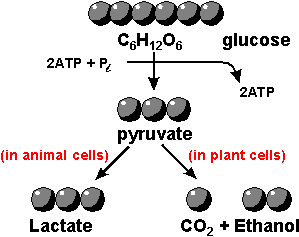
ATP is created during anaerobic or aerobic cellular respiration in the mitochondria of eukaryotic cells. During cellular respiration, the sugar called glucose (C6H12O6) and oxygen gas (O2) is converted into carbon dioxide gas (CO2), water (H2O), and ATP.
This ATP is used to move the myosin heads against actin. When this occurs, a muscle shortens and contracts. Muscles are attached to bones. When a muscle contracts, the bone to which it is attached moves. In this way, the chemical energy that is stored within muscle cells is converted into mechanical energy.


No comments:
Post a Comment